Test-Time Compute for Humanoid Behavior Foundation Models
Video Demo
Abstract
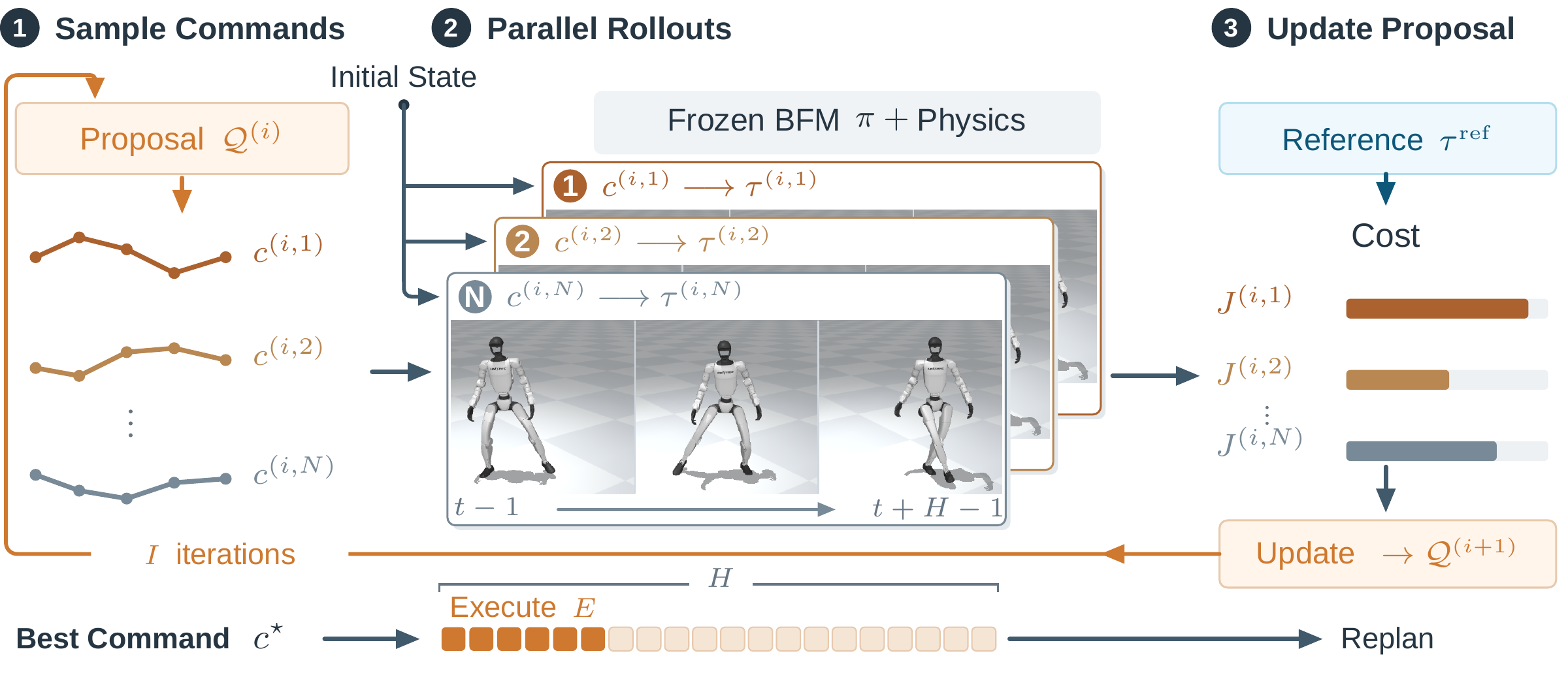
Humanoid Behavior Foundation Models (BFMs) can execute impressive motions, but downstream applications such as loco-manipulation demand high whole-body positional accuracy. Existing BFMs suffer from a systematic command–execution gap, where executed motions deviate from desired ones. We show that additional test-time compute can improve execution without retraining the BFM. First, we introduce Test-Time Command Optimization (TTCO), which adapts the input command to the specific BFM to produce an executed trajectory closer to the desired motion. TTCO finds such commands by sampling-based optimization through closed-loop simulations of the BFM and robot dynamics. Across three BFMs on the AMASS dataset, TTCO reduces mean global body-position error by 79–84% in simulation. Second, we analyze test-time compute scaling and derive an approximate compute-optimal strategy that can sustain performance gains as the compute budget increases. Third, TTCO can generate BFM-specific action labels from recorded robot trajectories without requiring the original teleoperation body-motion commands. Simulation and real-robot experiments show that these labels are effective for training high-level loco-manipulation policies. This method also supports reusing existing demonstrations across BFMs.
Results
The issue: the command–execution gap
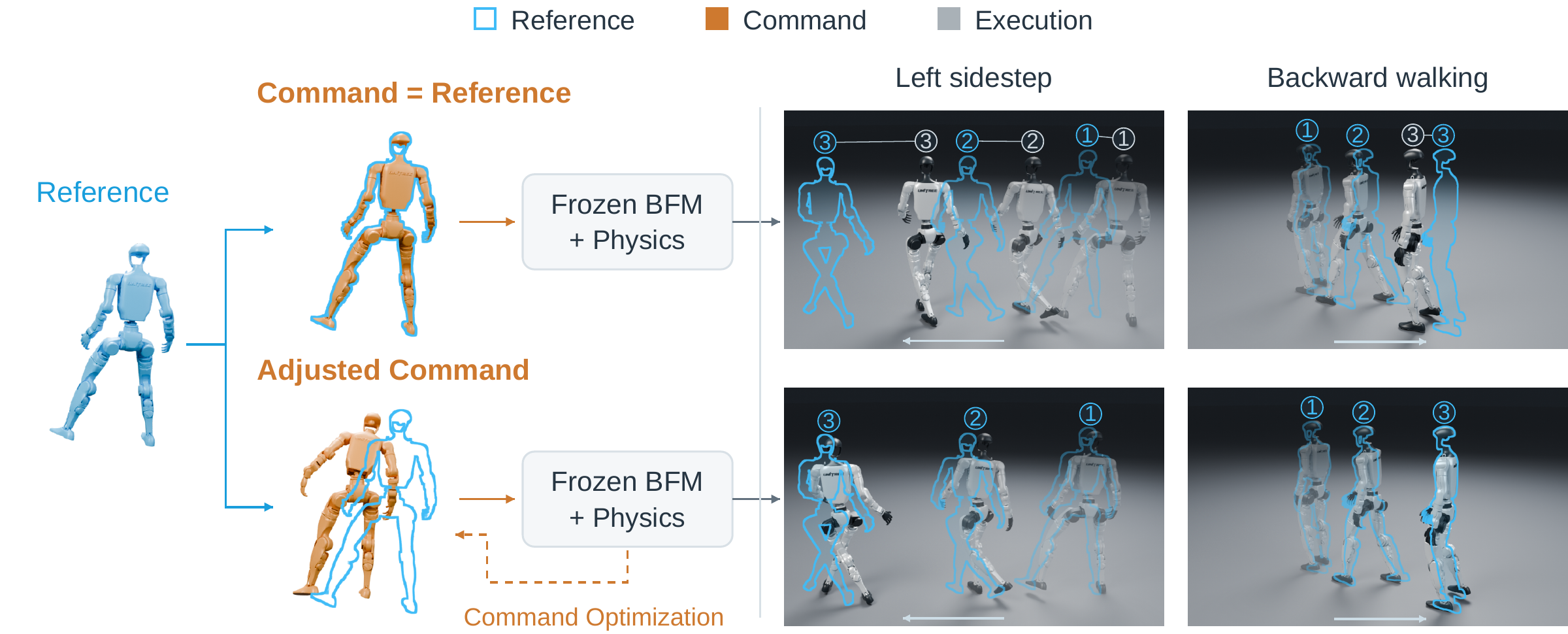
Current humanoid BFMs exhibit systematic deviations between desired and executed motions, a discrepancy we call the command–execution gap. A robot can complete a movement while its body drifts from the intended global position or its hands and feet miss the intended contact locations.
1. We introduce TTCO to improve motion-tracking fidelity in existing humanoid BFMs through test-time compute, without further training.
At inference time, the desired motion need not be supplied directly as the command to the BFM. TTCO finds adapted commands through closed-loop simulations of the BFM and robot dynamics. Across three pretrained BFMs and 12,273 AMASS reference motions, TTCO reduces mean global body-position error by 79–84% in simulation.
Mean global body-position error (m)
BFM
Nominal
Optimized
HEFT
0.271
0.057
SONIC
0.615
0.127
TWIST2
1.095
0.173
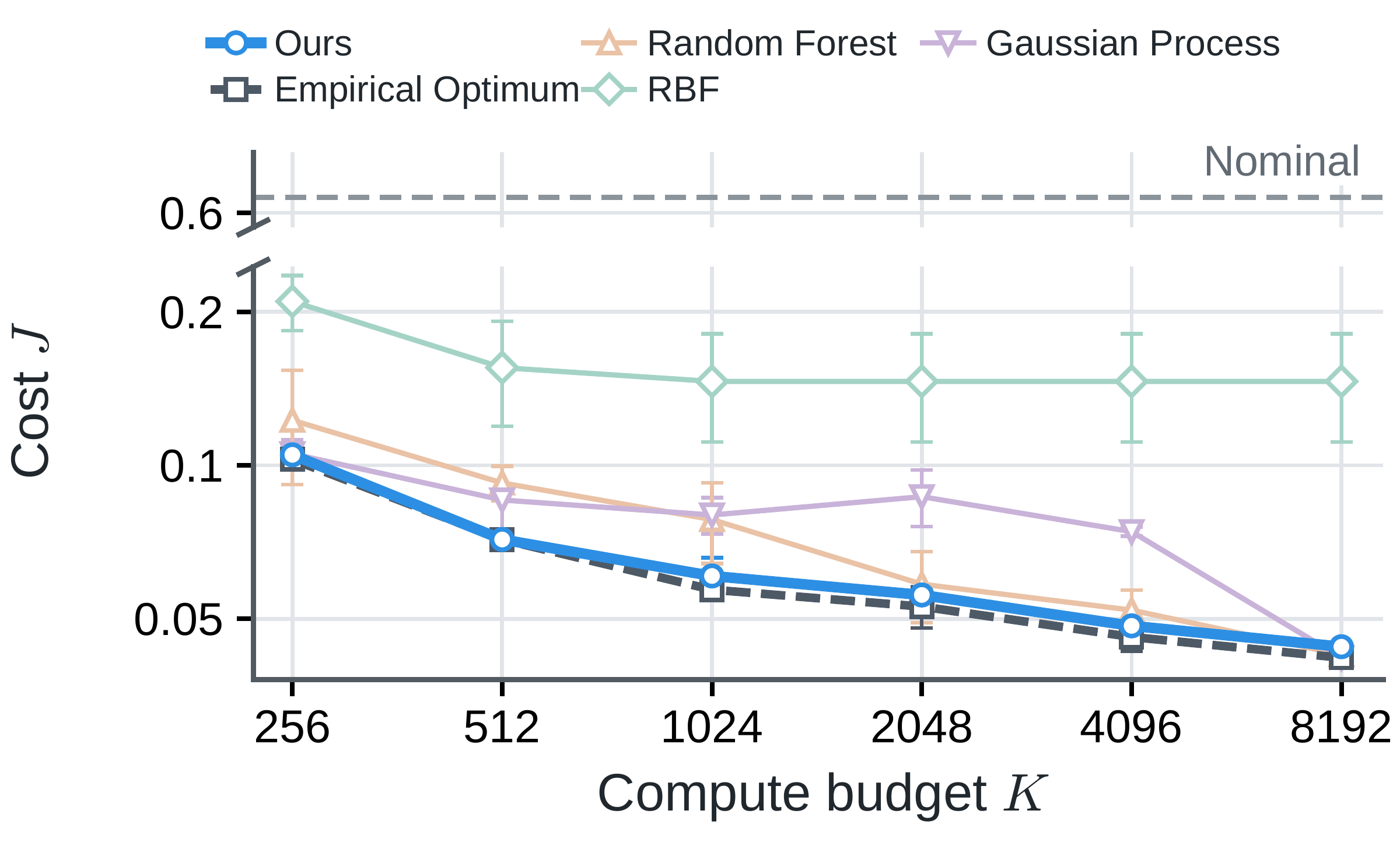
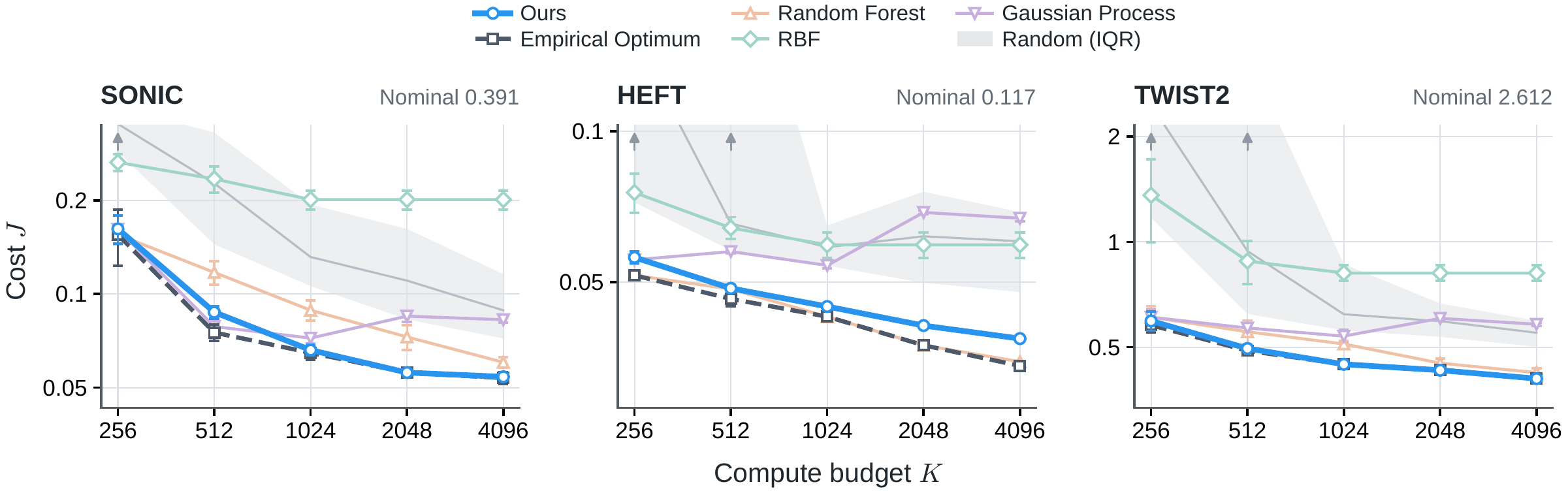
2. We analyze test-time compute scaling and derive an approximate compute-optimal allocation strategy.
The gains from command optimization depend on both the amount of compute and its allocation across candidates, optimization iterations, rollout horizon, and replanning. A surrogate cost model fitted to limited measurements yields a strategy that sustains performance gains as compute increases and generalizes beyond the motions and BFM used for fitting.
3. We extend test-time compute to high-level policy learning and demonstration reuse across BFMs.
Because of the command–execution gap, recorded robot trajectories may not directly serve as action labels for high-level policy learning. We apply TTCO offline to optimize body-motion commands against these trajectories while keeping the target BFM fixed. The optimized commands provide supervision for policy learning and can be re-optimized for a new BFM to reuse the same demonstrations.